






THE FOOTPRINT OF A GOD
Bacchini's poetry flourishes among different species, however, all question the mystery of life and death. Each of these poets is a Sign, they leave no marks, but they themselves are the Sign. In the cracks of the world they live in silence and there they come together, repair yourself, to the din of time, to the very strong of living and passing away. Of the perpetual cycle. The dark night, the black flash, the sragione, the limitless enormity of man, i eternal, the supernals have rejected them, after the storm, on unknowable shores, and unspeakable. There, in the surf, they give themselves back to us after the shipwreck.


I would like to write certain verses that I have had in mind for a long time. A kind of reversed Song of Songs. “I will go through the squares and streets, I will look for those whom no one loves". “O you who dwell in the gardens, don't let me hear your voice". I would like to write it in the most modern language, almost on the rhythm of a blue, and at the same time it should be solemn and pure – and also terribly alive – Like a little Goya. It is the Song of the Tongueless.
Cristina Campo
by Juan de La Cruz, Friedrich Holderlin, Cristina Campo, Clement Rebora, Pier Luigi Bacchini
Mise en parole and dramaturgy | Francesco Pititto
Visual elements | Maria Federica Masters
Interpreter | Valentina Barbarini
Production | Lenz Foundation
Duration | 35 minutes
The newly formed Lenz Foundation. Between Juan de al Cruz and Pier Luigi Bacchini.
by Giuseppe Distefano, Artribute, 26 April 2015
THE GOD OF LENZ
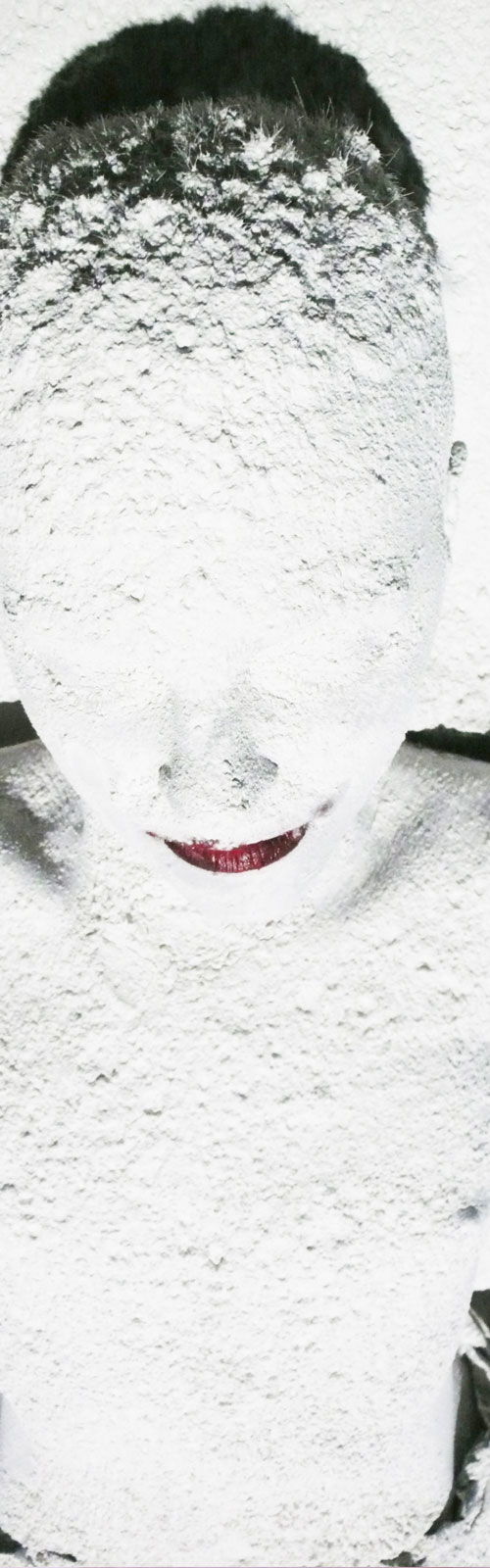
The imprint of a God combines verses and texts as well as those of Pier Luigi Bacchini, Clemente Rèbora, Friederich Hölderlin, Cristina Campo and Juan de la Cruz, figures that question the mystery of life and death. In this one put into speech Of Maria Federica Masters and entrusted to the interpretation of Valentina Barbarini, they converge, forming a single visual and sound dramaturgical body, the images of powerful corporality of Francesco Pititto and the sound research of Andrew Azzali.
On three big screens, the initial whiteness of two naked bodies fades onto the round shape of shaved heads in close contact; that fade, in turn, in the shape of three balloons; therefore on that of planets immersed in astral darkness; and alternated with the sequence depicting three physicists, one of which is similar to the Roman she-wolf at whose breast the others suck milk. To link the images and the verses, on an inner journey in search of God's imprint, And, in the vibrant twilight, the poetic body of the performer. First wearing a latex mask to recite the prayer of Juan de la Cruz, “I live without living in me, and so I hope, I die because I don't die”; Then, showing himself with his face uncovered. Cristina Campo's verses are pronounced with the mask of a tiger.
From time to time postures with pleading looks are assumed, adoring, lost, until the laying of a crucifixion. In these stations of the soul – solitary stages of echoes far from the din of time, voices resurfaced from the shipwreck of the dark night – the closing words of the Spanish mystic, “to arrive, ... to have, and… so as not to hinder Everything”, resonate on stage, epiphanic place of incarnation that alludes to a divine presence. The same one, moving to the Mayakovsky Hall, emerge in songs of the soul