





Disdemona
DISDEMONIA_DISDEMONA
Bad Star
In the Fabbrica a new interpretative plan of Verdi's opera is established: the violence emanating from the space of workers' work reduces Desdemona's body-voice to silence (Dis-demon), heartbroken, suffocated by the roar of Otello_Jago's 'polyphemic' voice and the obsessive sound of the industrial machines with soundtrack on stage.
Otello by Giuseppe Verdi with libretto by Arrigo Boito, Taken from the homonymous tragedy of William Shakespeare. It is the penultimate work of Verdi, with which the composer returns to the Shakespearean themes that had no longer faced Macbeth's era (1847).
Otello (titolo originale The Tragedy of Othello, the Moor of Venice) by William Shakespeare written in the early 17th century. Taken from a short story by Giambattista Giraldi Cinzio contained in the Hecatommithi. The first documented performance took place on November 1 1604 at Whitehall Palace in London.
Name of Shakespearean tradition, taken from the homonymous figure of the Otello; Shakespeare coined him based on Dismona, in turn a literary product of the writer Giambattista Giraldi Cinzio for his Hecatommites (One hundred novels). From the character of Shakespeare takes its name Desdemona, A satellite from the planet Urano. About the derivation of Disdemona, Cinzio probably baseed it on the ancient Greek δυσδαίμων (dysdaimon) o dysdenia (dysdaimonia, "misery"), with the meaning of "from adverse fate", “unfortunate”, “unlucky”, “born under an evil star”.
After the contemporary theatrical translations developed by 2014 al 2019, special creations for different editions of the Verdi Festival: Verdi King Lear_The opera that doesn't exist, Autodafé dal Don Carlos, Paradise_A Sacred Piece, Verdi Macbeth, Revounting rest, resumes Lenz's dialogue with Giuseppe Verdi's musical work.
Disdemona is included in the Atlas of Violence, the new three-year dramaturgical and visual culture project 2025_2027 by the Lenz Foundation, which through a complex program of contemporary performative rewritings aims to poetically transcribe themes such as conflict, the abuse, impiety, the violence of our time.
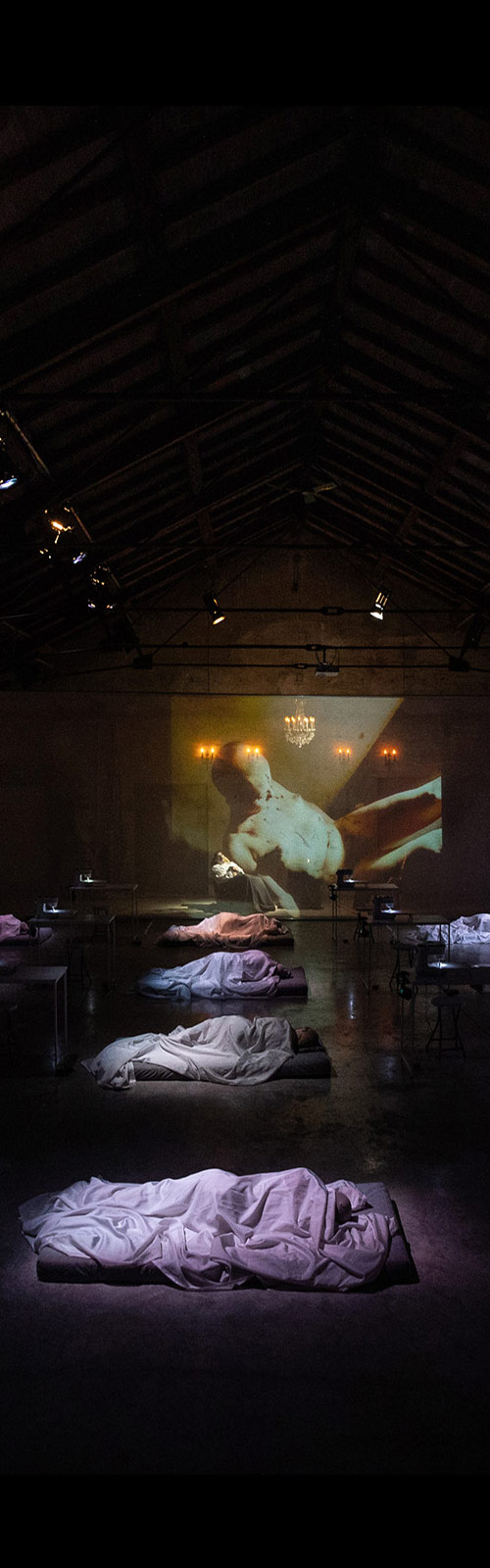
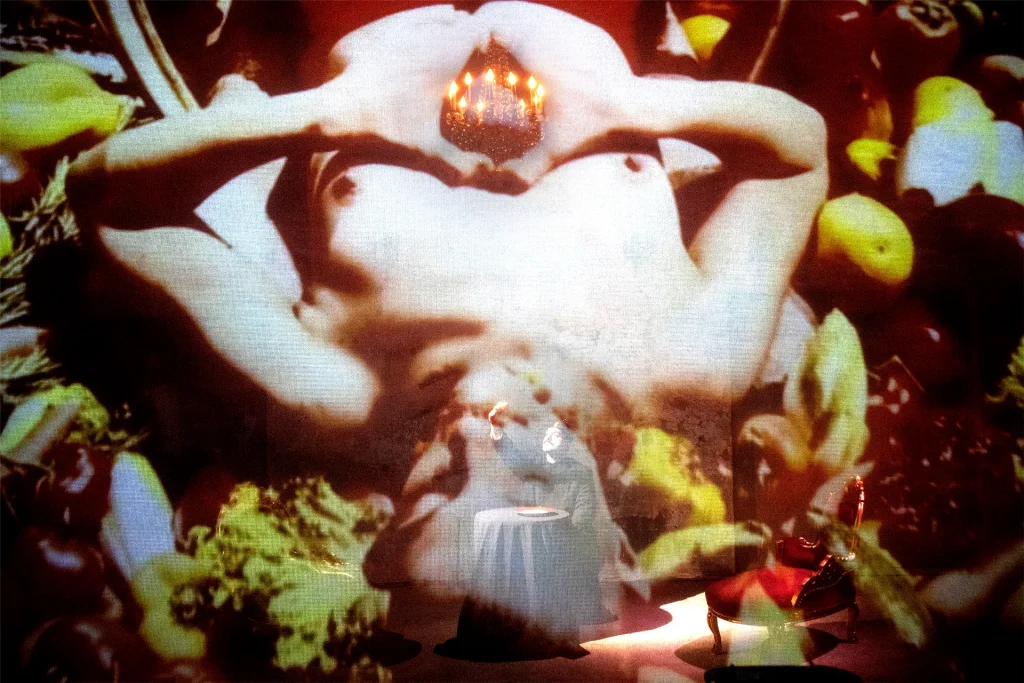
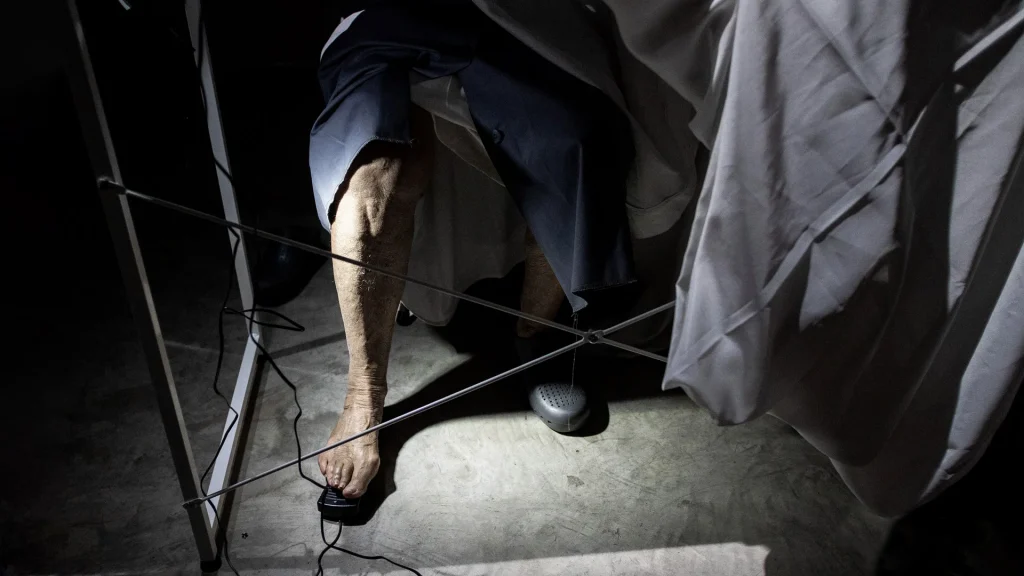
IN-PLODERE DIsdemona. The Factory of truth. From Othello and Othello to DESDEMONE Implode comes from Latin, “in-“ prefix indicating inward movement and “ploding” i.e. beating, hit, force out. DIsdemona implodes everything that exploded in the actions, in battles, in the tragedies of the great heroines who outlined its form, or simply women, figures of never reconciled females. Desdemona's character announces itself there, in the act that is missing in the booklet but that decision, beyond any convenience of a daughter, it is the foundation of every subsequent action, of any future premonition. Only she will allow everything to happen, only she could have escaped from that implosion of madness But it won't happen, it will be his choice to swallow the last star. What shape should we give to this model?, that could contain both the linguistic-musical innovation of Verdi's penultimate opera and the figure so similar to Shakespeare's Juliet and to many other heroines who have appeared in our works – Antigone, Smoking, Elena, Iphigenia, Diotima, Margaret, Catherine of Siena, Dido, Angelica, Ermengarda, Lady Macbeth, Cordelia, Eurydice, Phoenix, Pentesilea, Juliet indeed. Implode this powerful fresco of rebel forces in a single body of actress? In a contemporary sign Perhaps, again, in returning to Hölderlin's zero, to the image he says about the haiku, to the marked body, The machines sew at a paroxysmal pace, violent, excited, the needle penetrates the fabric of the mind, of the senses, of the body. The words and gestures of the male figures in the work weave the plot of an enveloping fabric, repetitive, which layer upon layer beats the rhythm of power, of the incessant work destined to produce the dramatic-musical chains, the assembly lines that lead things to always be things, things always things. Because one thing is Disdemona for Othello and Iago, ownership and pretext, and the worker on the machine destined to produce is one thing. Like a veil (or large handkerchief imbued with magic) his figure was sewn, from needles and threads of a concerted fiction, a one-way score of give and take, of distant irreconcilable perspectives, of views as adverse as his destiny. You feel the same empathy, suffered on the field, by Simone Weil when she describes the female workers in the factory, what they do and what they shouldn't do, if they know what they are doing and what they shouldn't know, whether they are alone or all together, what disgusts them and what makes them proud. Staplers become real image Disdemona is an image of rupture, of a broken thing since it has become a thing, but what to lose for those who cannot stand up to its dramatic and true stature. Disdemona prefers to fall asleep, Don't die on stage, to be able to go back to work tomorrow, aware that to the point 1 of that list it is written about the ideal that does not yet exist: INSTALLATION DRAWING DISDEMONA EMOTIONAL CONTACT ° SENTIMENTAL PICTORIAL ° STATICS OF PAIN ° PLASTIC ROOTING OF VIOLENCE In the Fabbrica a new interpretative plan of Verdi's opera is established: the violence emanating from the space of workers' work reduces Desdemona's body-voice to silence (Dis-demon), heartbroken, suffocated by the roar of Otello_Jago's 'polyphemic' voice and the obsessive sound of the industrial machines with soundtrack on stage. The rhetoric of the paroxysmal erotic-amorous act is replaced by the truth of the condition of exploitation of working women, killed by working on the assembly line, crushed by the primacy of mechanical production over the dignity of human life. Both dramaturgical functions are inserted into the figuration of the male/master – Othello and Iago – equally guilty of Desdemona's death and the violence suffered by Emilia, represented on stage by a plurality of women workers. In the theatrical design of 'Disdemona' the moral responsibility for the violent act is not 'divided' between the deceived powerful person and the deceiving subordinate, but reunited in a single sound source, the voice transmuted electronically (live) of a single two-headed performer, Otello_Iago, like Orthro, the large two-headed dog with the serpent's tail of Greek mythology. The space is divided into 2 start from a netted tulle backdrop behind which the singer is in action in the double role of Othello/Iago. The space operated by Otello_Jago is in a bourgeois environment illuminated by a drop chandelier and a pair of stylish wall sconces in which a daybed in red velvet and gilded wood is placed, a small dining table. Imagoturgical flows of a female macrobody object of the desires of the male/master/Othello/Iago are projected onto the backdrop. The front space is occupied by an installation of 12 sewing machines and as many mattresses placed on the floor next to the workbenches, a space of psychophysical constraint that does not provide a distinction between work and private life, between toil and rest and denies women any intimacy. The interpreters/Desdemona/Disdemona act in this space (1 singer and 1 actress) e 10 movers_operaie. To replace the rhetoric of the 'handkerchief' a system of large multiple sheets, shrouds sewn and stitched continuously by the movers_workers during the performance action. BAD STAR I die innocent DISDEMONIA_DISDEMONA Visual and sound performative creation for Festival Verdi 2025 Alessandro Rigolli, The Music Journal
Everything inside, like in a huge black hole of living, of predicting, of feeling in the body, in every part of the body before in the mind.
In Othello, of both Shakespeare and Verdi/Boito the entire dramatic and musical movement preludes the violent ending, from the beginning and throughout the Shakespearean plot there is a progressive flow towards that single outcome, the wave moves, it slams and rises, as in the storm that shakes the returning ships, and the echo of the impetus can also be felt, paradoxically, in the absence of the Venetian background that Boito does not choose.
The protagonists seem to know what will happen, she and Othello and Iago in a plot fiction that
it wraps itself around his body, on his silences, on his alleged adherence to the fate of the evil star.
and of feeling.
that contains the mass necessary to make the drama explode? The action, the fact?
to the noise of the factory and the work that has always inhabited the place and thought of our actions, and again Simone Weil and her literary strength, poetics and politics, in its in-plosion every pain in the world.
In a constant sound of rising waves and sewing machines.
of a collective sentimental projection, a tragic and musical chorus.
“Don't forget that SLEEP is the most necessary thing at work,” Weil writes to the point 8 of a list of ideal things for working women.
“That there was authority only OF MAN OVER THING and not OF MAN OVER MAN.”
This is Disdemona's only real kiss, again and again and again.
His voice is amplified and electronically modified live by the musician Andrea Azzali.
AH_Mother tongue of sentimental motion
It says about the vinegar density of the palpate ah, rope stretched between the arms,
when it shows itself it hurls unexpected sighs on the fine hearing.
The good one, the beautiful one, the naive one rises with parched breath.
Gallop shouts, high-pitched voices and wildly sounded words of smile and moan.
He knows nothing except the fatigue and pain of the final squeeze.
Lineage of tragedy, nature does not squander forces,
while God is scarce in help and generous in punishment.
In a ceremonial dress he cannot stand, but he lies down to support the weight of his anxiety
in the sunset of the noisy male.
Ah_for sharp eyelids that colorless tears continue to generate.
Ah_for the sudden pangs and the iron shocks in the heart of the queen of lament.
Ah_because it disappears and vibrates, moistens, startles in the mother tongue.
Deep down, let her be a communist wolf and not a crista lamb,
at least in the final strength of his Ah.
Bad Star
By Giuseppe Verdi, William Shakespeare e Simone Weil
Dramaturgy, imagoturgy Francesco Pititto
Composition, installation, wrappers Maria Federica Masters
Sound processing Andrew Azzali
Music consultancy Adrian Engelbrecht
Interpreters Valentina Barbarini, Giulia Costantini soprano, Lorenzo Marchi tenor
Movers Tiziana Chapel, Giuseppina Cattani, Silvia Cleonice, Fabrizia Dalco,
Nicole Dayanna Gonzalez, OLHA LOPATYNSKA, Ivana Manferlli, Giada Michelle Mbock,
Valeria Moscardino, Elena Nunziata, Agatha Pelosi, Carlotta Spaggiari
Light design Maria Federica Masters, Alice Scartapacchio
Production manager Giulia Mangini
Technical setup Alice Scartapacchio, Lucia Manghi
Treatment Elena Sorbi
Organization Ilaria Stocchi
Communication, Press office Giovanna Pavesi
Diffusion, graphic care Alessandro Conti
Photographic documentation Elisa Morabito
Video documentation Black Lapine
Production Lenz Foundation
With the support of Ministry of Culture, of the Emilia-Romagna Region, of the Municipality of Parma, of the AUSL DAI SM-DP, of the University of Parma and the Teatro Regio_Festival Verdi
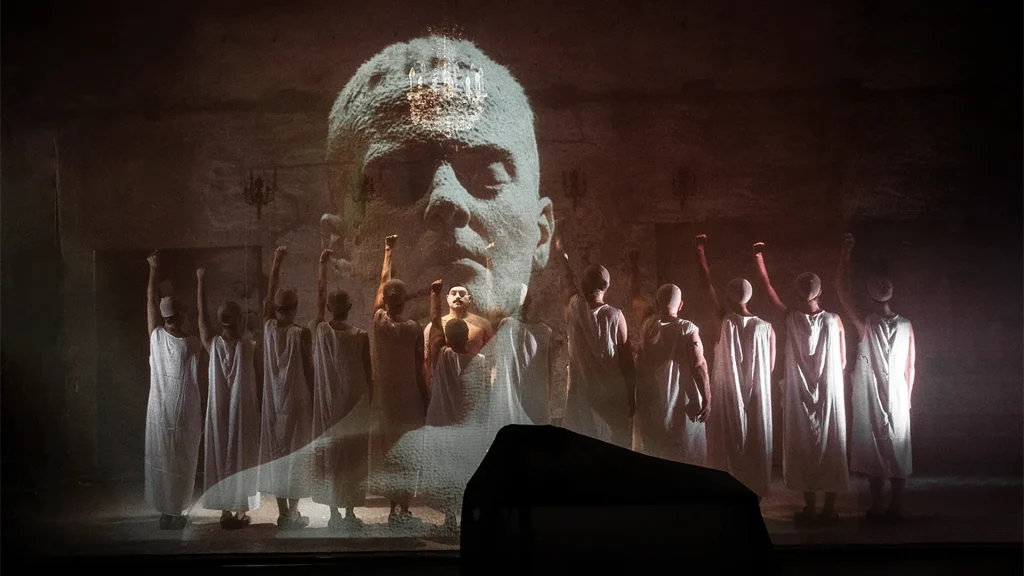
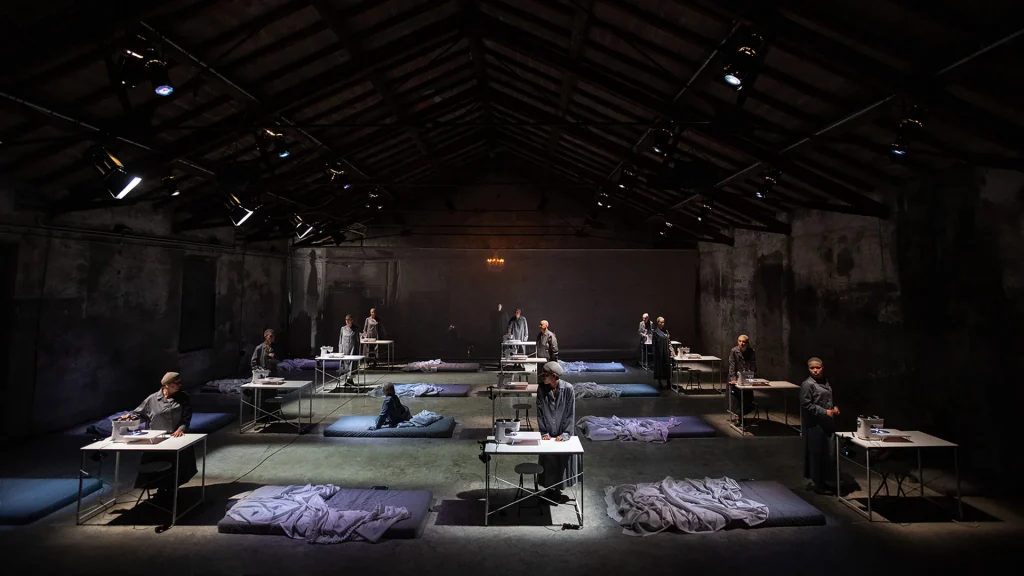
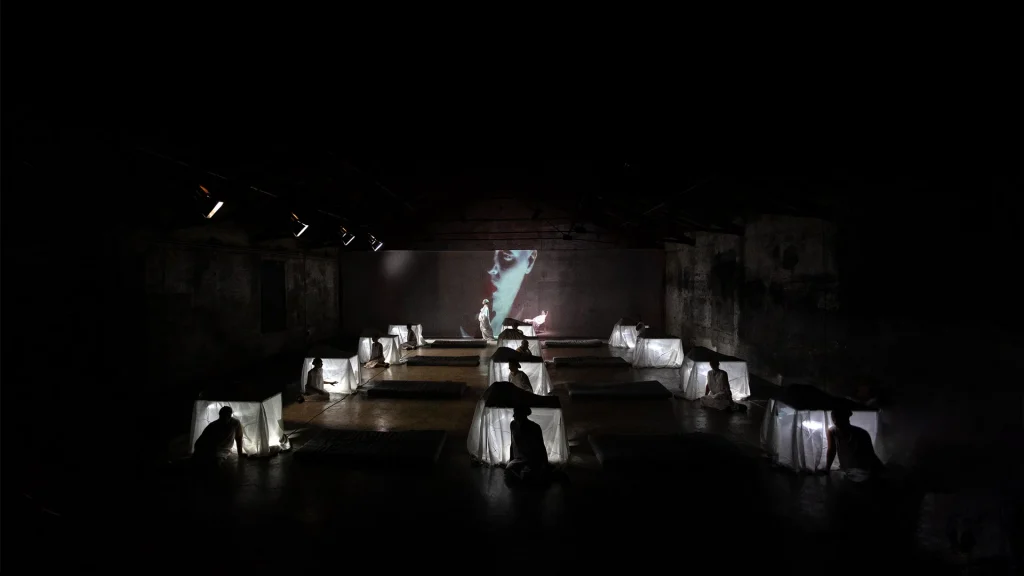
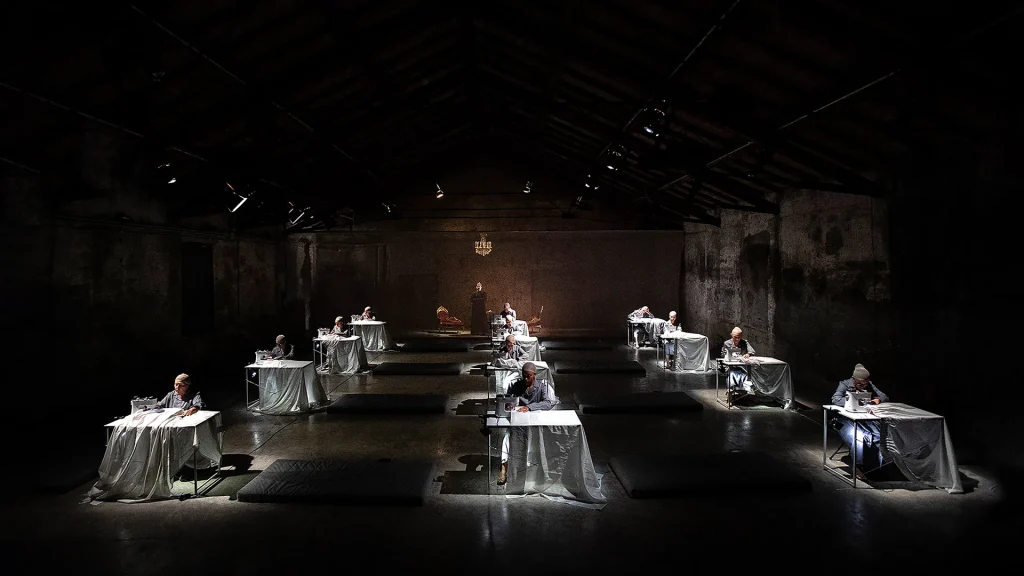
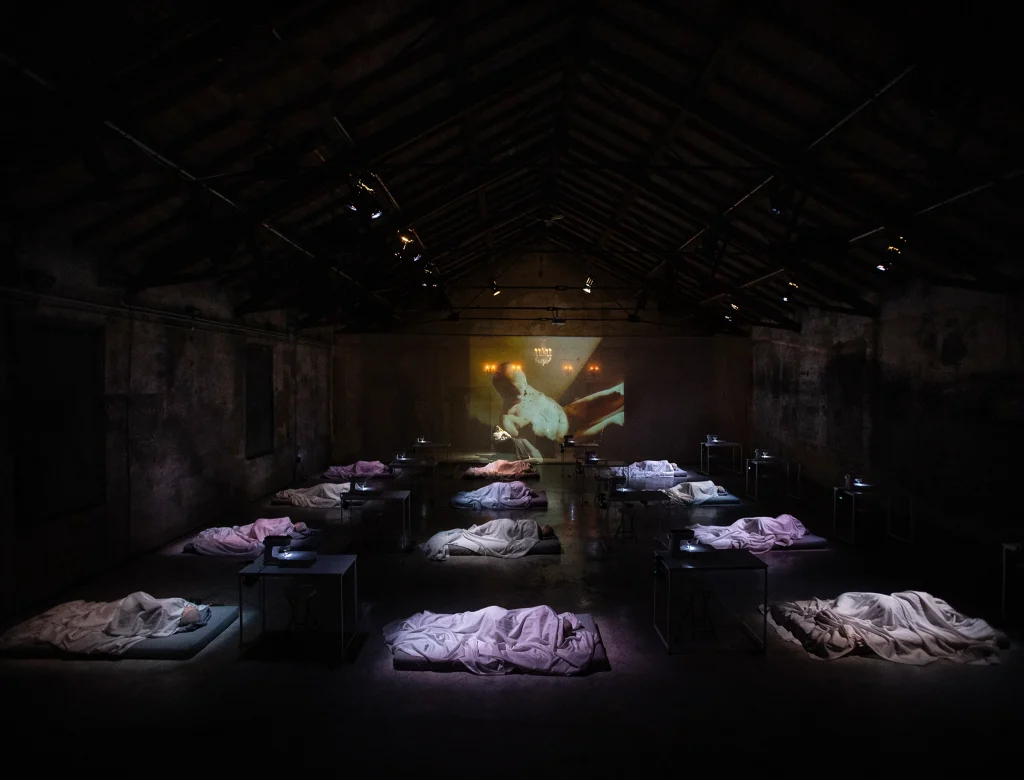
An intense stage action - in which the petty cowardice of the prevaricating man is contrasted with the disarming courage of the woman capable of eating her own heart - well returned by the commitment of the actress Valentina Barbarini, from the voices of Giulia Costantini (soprano, already a student of the Verdi Academy) and Lorenzo Marchi (tenor) and by the stage presence of the twelve women who designed the movements in the theatrical space of the Mayakovsky Hall [more].