







CATHERINE OF SIENA
Catharina von Siena is an unfinished drama written by J.M.R. Lenz, in different processes, at the end of the eighteenth century. Lenz Rifraczioni proposes an original one “put-in-word” (put into words) of a previous staging staged by the Company in two different versions in 1987 It is in the 2000, freely adapting the original version. Already in the latter the reference to the Saint of Siena is purely imaginary – just think of the figure of Correggio, lived two hundred years later – and a pretext for the development of a dramatic and experimental idea. A characteristic of Jakob Lenz is, Furthermore, that of being considered an anomalous romantic playwright paradoxically for his style “tragicomic”. From a painter's tragedy to a first inspiration, Catharina von Siena became the tragedy of a saint who fights temptations with penance. Both the original writing and the new version have no hagiographic intent.
Nonetheless, the staging artistically translates the intensity of Saint Catherine's mystical practice and some passages present particularly engaging mystical tensions.

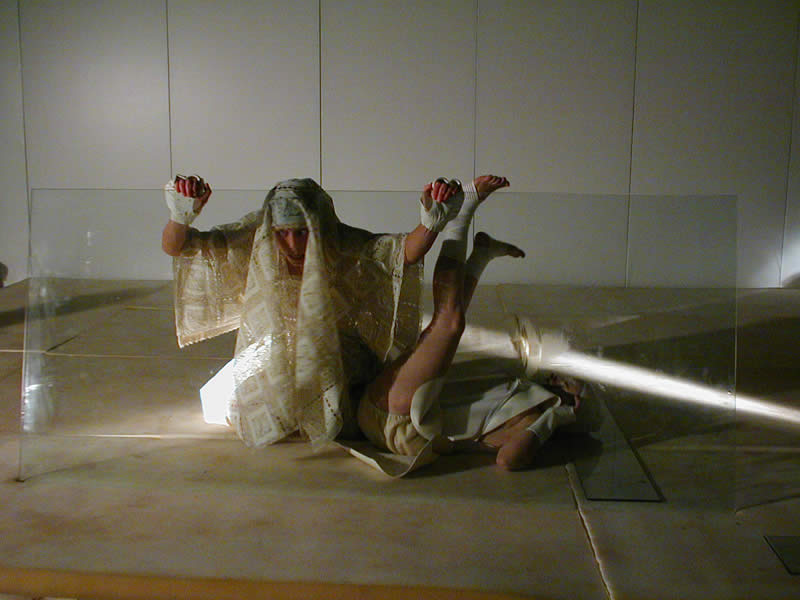
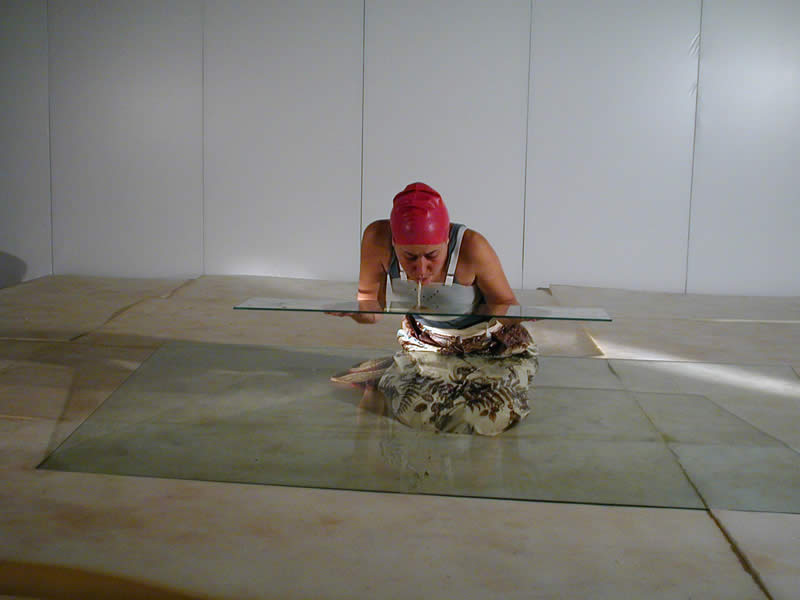
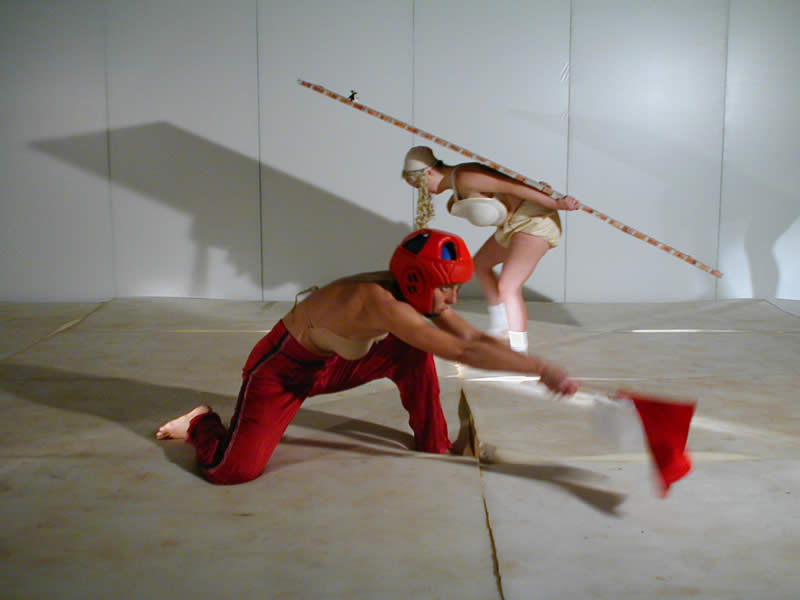
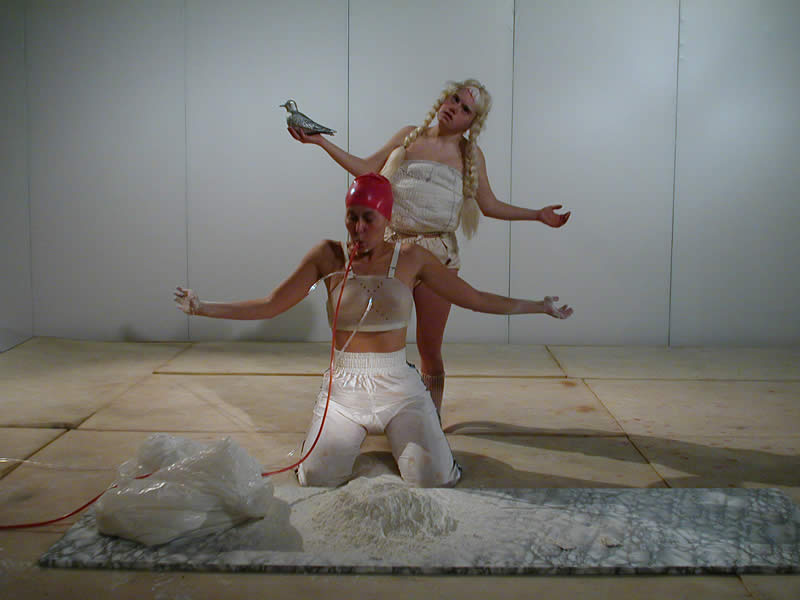
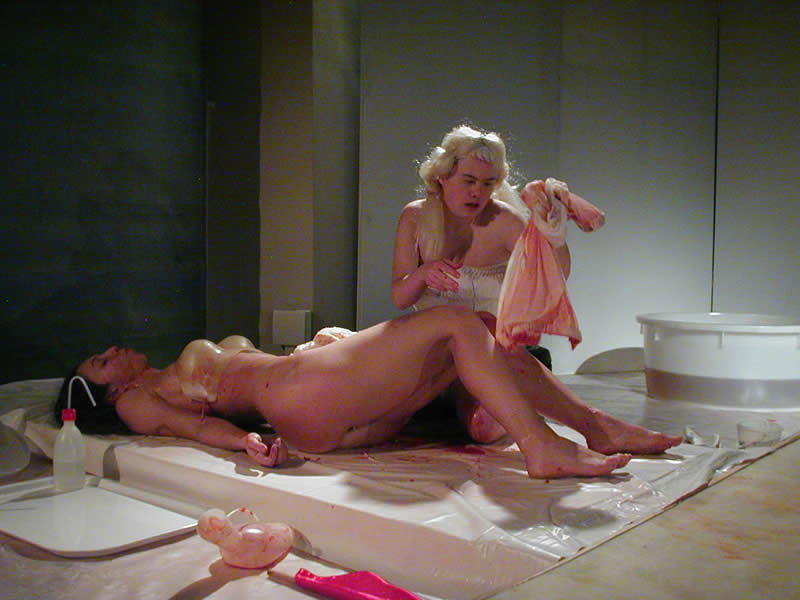
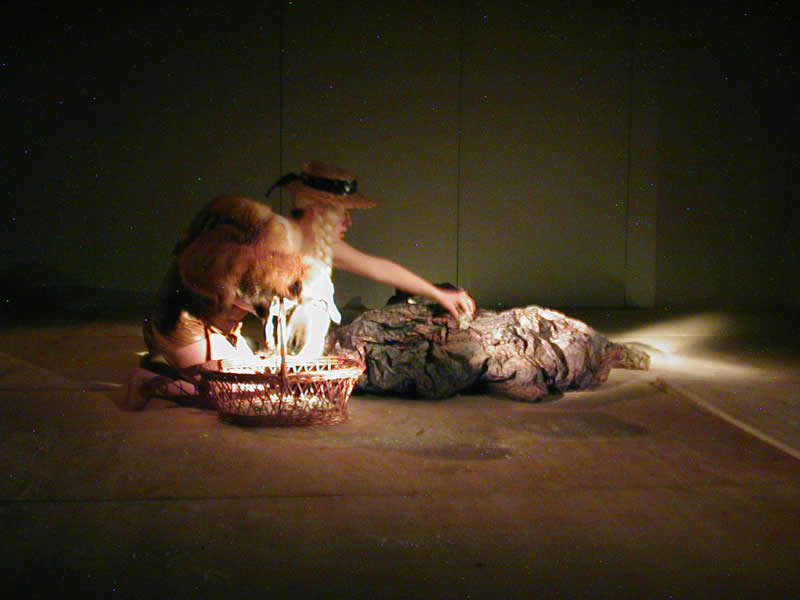
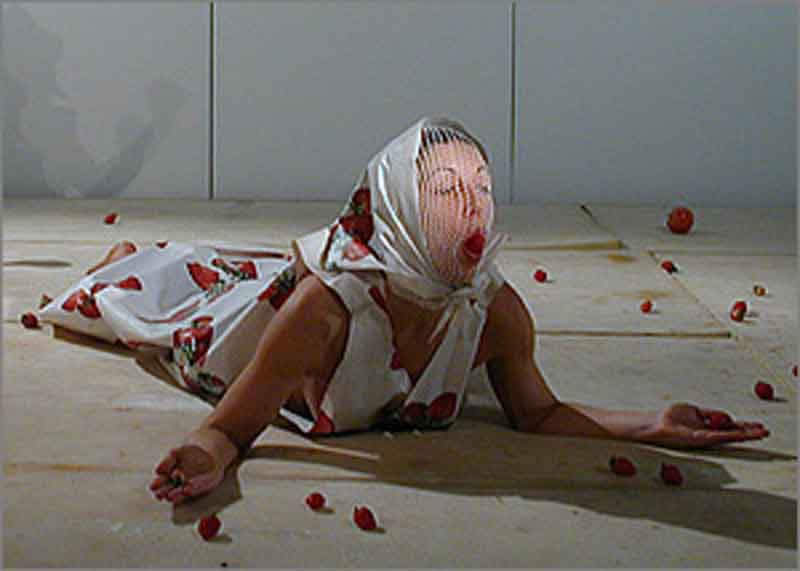

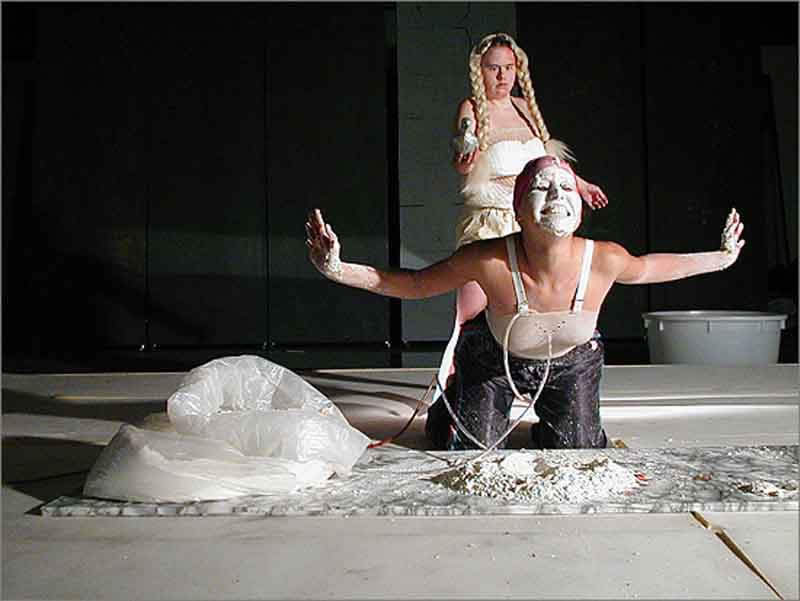
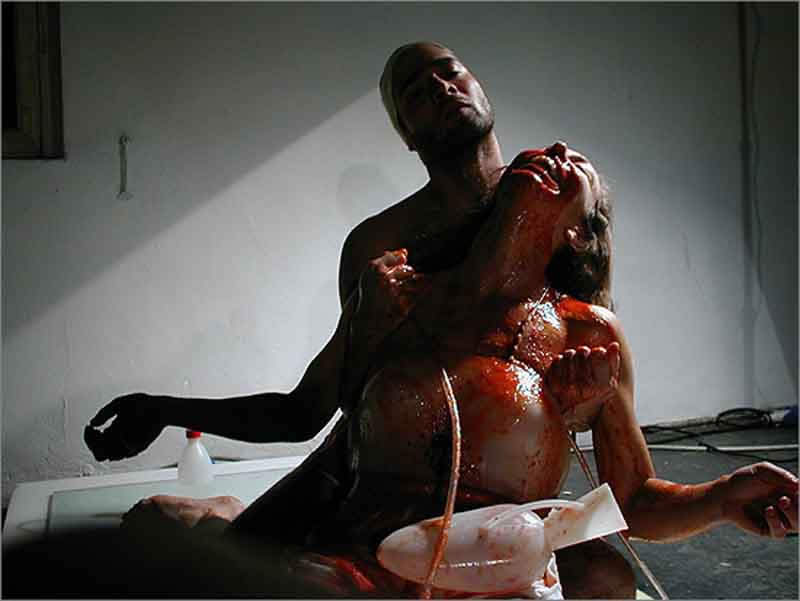
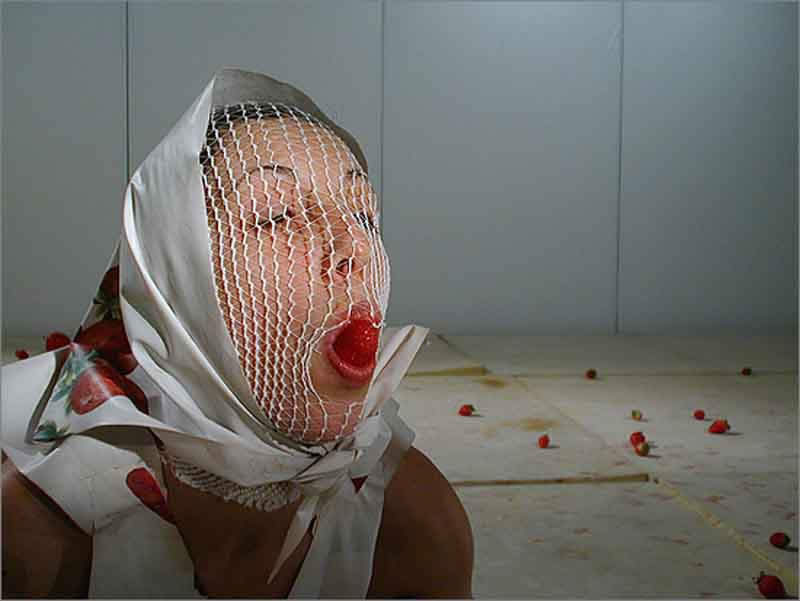
In the adolescent fury of the first apparitions, in the suffering of youthful visions, in the mystical ecstasy of the maturity of Jakob Lenz's romantic Catherine, the poetic age of Lenz is reflected in an authentic portrait. Refractions. In the scene, a bare field framed by a white inorganic painting, the time of mystical action is sculpted: Catherine is the phenomenon of God, the traces of his presence are engraved in it. Holy action and divine contemplation are accomplished in thirteen trials, each of which reveals the matter and space of the epiphany. In Lenzia's dramaturgical invention, Caterina sinks into a distorted biographical landscape, where together with some figures taken from the saint's hagiography, other unexpected ones appear such as the unlikely one of Correggio, lived centuries later, in an exhilarating mix of literary inaccuracies and historical misunderstandings typical of German Romanticism. Maria Federica Maestri's directorial architecture was inspired by this same formal paradigm, who did not outline any historical-narrative reconstruction of the saint's life, but he obeyed only the letter of the poetic truth of the theater. The show is a succession of arduous sanctifying practices that lead Catherine to bliss.
The celestial bride, penitent lamb, you take a breath, saliva, ointment of Jesus in the full fulfillment of the scourge. Caterina's baby body, nourished only by the host and blood, he asks in a high-pitched voice to belong to the world of excess and to return to the extraworld of his infantile nature. Blessed because without food, blessed because quenched by his own spit, blessed because dirty and without dignity. Caterina drowns in the kingdom of youth with livid and swollen veins, of queens with protruding bones, of the schoolgirls of eternal regurgitation. Little Caterina wants to die. He wants to die in the theater. And the theater must die in Caterina, becoming cold itself, silent and rigid. His Resurrection is in the truth of the body, without identity, without will, without necessity, free to be God's red strawberry.
Catharina von Siena's musical dramaturgy is divided into a sequence of songs ideally conceived as a spiritual epistolary: exciting, Freddo, sentimental, romantic. The timbral matrices originating romantically in the letters belong to the virtual heritage of some sound cards processed with the sampler. The rhythmic nuclei are built and developed on fragments of musical pieces belonging to our recent history of rock music and reproduced through the programmatic grammatical procedures of a computer; genres and styles change radically from letter to letter, creating a sound itinerary of unpredictable references and visions: counterpoints to see, abandonment of the ear to the vision of intimate listening, enraptured in the multiple preciousness of the details of a Correggio fresco transformed into musical drawings and colourings. The original music, powerful electronic reworkings composed by Adriano Engelbrecht and Andrea Azzali, were collected on a CD published in 2000.
Nota su Jakob Michael Reinhold Lenz
Romantic Enlightenment for Georg Büchner and Modern Virtue by Bertolt Brecht, Jakob Lenz is the poetic and intellectual model of the initial movement of Lenz's theater Refractions.
Wedding of names and works: from Lenz, the company's first staging based on Büchner's novel, debut in the passion for scenic language (1986), to the dramaturgical lesson on the sanctity of art of the four unfinished drafts of Catharina von Siena (1987), to the unreconciled theatricality of The Soldiers (1987), tragic and dissonant fresco on the humiliation of the feeling of love. Ten years in the time of artistic and poetic research between the words and silences of Hölderlin, Kleist's dramatic lightning strikes, Mayakovsky's explosions in verse, the polyphonies of the solitude of Dostoevsky's characters, and the final arrival at the nostalgic magma of Shakespeare's sentimental extremism and the human architecture of Goethe's Faust. After a short and intense study carried out with a group of teenagers, with this third staging by Catharina von Siena the past returns to itself, as if eager to restart its origins in the cold of the Lenzian fire. Two intense preludes for two recent stagings: il Pyramus und Thisbe, the translation of the episode of Ovid's Metamorphoses inserted in the original text by Francesco Pititto I-Ay-Eye and Shakespears Geist, exhilarating poetic monologue dedicated to the Actor and the Theatre.
Jakob Michael Reinhold Lenz (1751-1792) was born in Latvia and studied theology in Konigsberg, then working as a tutor in Strasbourg. He knows Goethe, with whom he becomes a friend, admirer and emulator. Lenz fell in love with Goethe's sister, Cornelia Schlosser. She gave him her own copy of Petrarca's songbook and inspired him by the unfinished fragment of the “Catherine of Siena” which from the tragedy of a painter became the tragedy of a saint who fights temptations with penance. In the 1777 his already precarious psychic balance is broken: three years of illness and suffering follow (described by Büchner in the story “Lenz”). In the 1779 he is brought back home by his brother: Then, every trace of Lenz is lost; He was found dead on a Moscow street in 1792. Among his dramas: “The preceptor”, “The new Menoza”, “The soldiers”.
“In every era, philosophy, or rather the mania for philosophizing, when it becomes a trend, it represented the greatest danger for the language. If we enter the homes of those who are called, by convention, the common people, if we pay attention to their interests, to their passions and we understand how nature expresses itself, when certain circumstances require it, outside of every grammar and every dictionary - what an immense enrichment of our refined language, what multiplication of our board games! Our operettas owe their success on the stage only to the noble feelings and natural expressions which they transfer from the lower classes of our refined and corrupt societies.” J.M.R.Lenz (1776)
CATHERINE OF SIENA
by Jakob Michael Reinhold Lenz
translation and rewriting || Francesco Pititto
regia | scenic elements || Maria Federica Masters
costumes || Maria Federica Masters
musica || Adrian Engelbrecht | Andrew Azzali
interpreter || Elisa Orlandini | Matthew Ramponi | Sandra Soncini
production || Lenz Refractions
first || Lenz Theatre. Parma, 2004
duration || 60 minutes